

Whether your kitchen is spacious or cozy, a reliable can opener is a kitchen essential. From opening canned veggies to serving your feline friend’s favorite dinner, manual can openers are compact, cost-effective, and space-efficient compared to electric alternatives.
Our team thoroughly researched and tested various top-rated manual can openers in real home kitchens. We assessed each opener based on design, performance, ease of use, cleaning, and overall value to provide a comprehensive evaluation.
Top pick
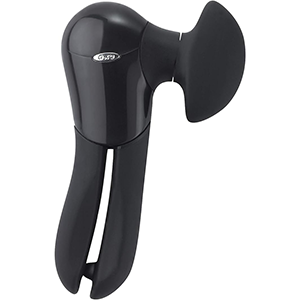
OXO 1049953
Effortlessly opens cans, leaving no sharp edges. Smooth oversized side-wind mechanism, soft-grip knob, non-slip handles, and built-in pliers for contact-free lid removal.
Editor’s choice
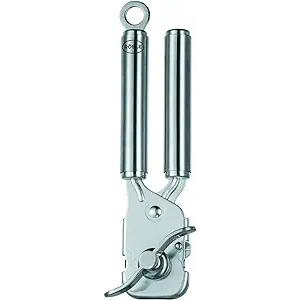
Rosle 12757
Durable 18/10 stainless steel construction. Effortless can opening with secure pliers. Ergonomic thumbscrew for comfortable turning. Safe lateral cutting wheel. Convenient hanging ring for stylish storage.
Best value
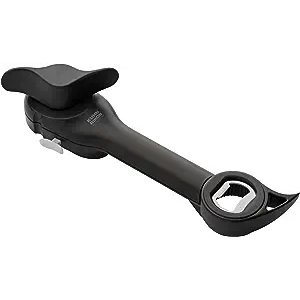
Kuhn Rikon 5-in-1
Versatile 5-in-1 gadget opens standard/ring-pull cans, crown-cap bottles, screw-top bottles, and jars. ‘Lock-on’ technology, safe, and hygienic. Mini-pliers for lid removal.
1. OXO Good Grips Smooth Edge Can Opener
The OXO Good Grips Smooth Edge Can Opener stands out as a top choice with its high ratings. Its side-wind mechanism effortlessly cuts through cans without leaving any sharp edges. Crafted from premium stainless steel, it’s dishwasher safe for convenient cleaning. Users appreciate the excellent value and well-thought-out design.
Following the OXO tradition, this can opener prioritizes comfort. Its handles lock together, eliminating the need for continuous squeezing during operation. The soft-grip knob, conveniently positioned on the side, turns effortlessly. For added convenience, the built-in lifting tool helps remove the lid without creating a mess.
Pros:
- Safe and smooth side-cutting
- Comfortable handles and crank
- Easy cleaning
Cons:
- Small learning curve
2. Rosle Stainless Steel Can Opener
For those unconcerned about cost, this stainless steel can opener is the optimal choice. Its high-quality material ensures durability, resisting rust and tarnish while adding an aesthetic touch to any kitchen. The sealed cutting mechanism rarely requires cleaning as it avoids contact with food.
Featuring lateral cutting, this opener guarantees no sharp edges that could pose a risk to fingers. Additionally, it cuts in a way that leaves the outer lid rim intact for temporary storage. During our testing, the standout feature was the built-in pliers, facilitating quick and sanitary lid disposal. The opener operates seamlessly, opening cans in approximately 20 seconds without leaving rough or sharp edges. Its handle includes a hole for convenient hanging storage.
Pros:
- Heavy-duty stainless steel construction
- Safe and smooth side-cutting with replaceable lid
- Blade never comes in contact with food
Cons:
- Pricier option
- Can be difficult to crank for some
3. Kuhn Rikon Auto Safety Master Can Opener
For families with kitchen-savvy children or teenagers, a can opener with side-lid cutting, eliminating sharp edges, is a wise investment. Our top choice in this category is the Kuhn Rikon Auto Safety Master Can Opener, garnering over 1,400 user reviews at a reasonable price.
This can opener operates without the need to squeeze the handle; it automatically grips the can when you twist the top handle. If the lid proves stubborn, mini pliers are at your disposal for easy removal. A side button releases the lid directly into the recycling bin. Additionally, the product boasts a built-in bottle opener, a twist-off bottle opener, and a hook for effortlessly grabbing pull tabs on cans.
Pros:
- All-in-one can and bottle opener
- Safe and smooth side-cutting
- Easy-to-turn knob
Cons:
- Not as comfortable as other models
4. Bartelli Soft Edge 3-in-1 Ambidextrous Can Opener
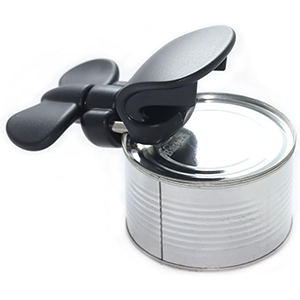
Catering to individuals with limited dexterity in one hand, this three-in-one can opener offers a safe and adaptable solution. Designed for both left and right-handed users, its no-squeeze single-handle design, coupled with an easy-to-turn knob, alleviates concerns for those with arthritis or joint pain, eliminating the need for excessive gripping or squeezing. Operating from the side of the can, it ensures a lid removal process without sharp edges.
The convenience extends to the effortless lifting of the lid without the hassle of fishing it out from the food. Compact in design, the tool’s versatility shines with an integrated bottle opener and a jar opener, streamlining kitchen space.
Pros:
- Ideal for those with weaker hand strength
- Safe and smooth side-cutting
- Multi-use bottle and jar opener
Cons:
- Blade only turns in one direction
5. Zyliss Lock N’ Lift Can Opener
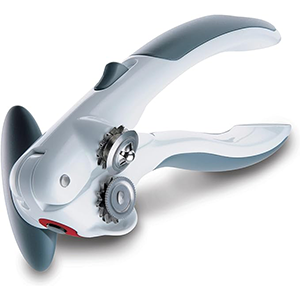
Among hand-cranked can openers, the Zyliss Lock N’ Lift stands out for its remarkable comfort. The wide non-slip grip on the handle allows for easy hand wrapping, and once clamped onto the can, the handles lock together, eliminating the need for continuous squeezing while cranking. This seemingly small advantage becomes appreciated, especially after multiple cans.
Featuring a magnetic lid holder, the Zyliss Lock N’ Lift grabs onto the can’s lid after detachment, preventing the messy task of retrieving it from the can or risking cuts by bending the lid back. While not foolproof, this added feature is a convenient touch. The can opener boasts a graceful design, lacking in some commercial-style counterparts. Easily washable by hand and appropriately sized for drawer or utensil jar storage, this can opener combines efficiency with a touch of comfort.
Pros:
- Locks onto cans for cutting
- Magnet grabs can lids
- Comfortable handle
Cons:
- Slight learning curve
- Lid can fall into the can
- Magnet doesn’t always reach the cut lid
What to Consider When Purchasing a Manual Can Opener
Hand Crank
Manual can openers necessitate some level of hand strength for cranking. A quality can opener should have a smooth-turning crank mechanism with minimal strain. Designs vary, with flat or curved knob-style cranks being common. Larger knobs or handle-style cranks with end knobs provide easier handling and greater leverage during operation.
Handles
Ergonomic handles contribute to ease of use. Opt for handles featuring a non-slip grip that comfortably fits in your palm. Some models offer handles that lock together while cranking, reducing the need for excessive squeezing and enhancing user convenience.
Conclusion
The OXO Good Grips Smooth Edge Can Opener earns our top spot for its high-quality stainless steel construction, user-friendly design, and easy cleaning.
For those on a budget, we recommend the Bartelli Soft Edge 3-in-1 Ambidextrous Can Opener as our budget-friendly choice.


Leave a Reply