
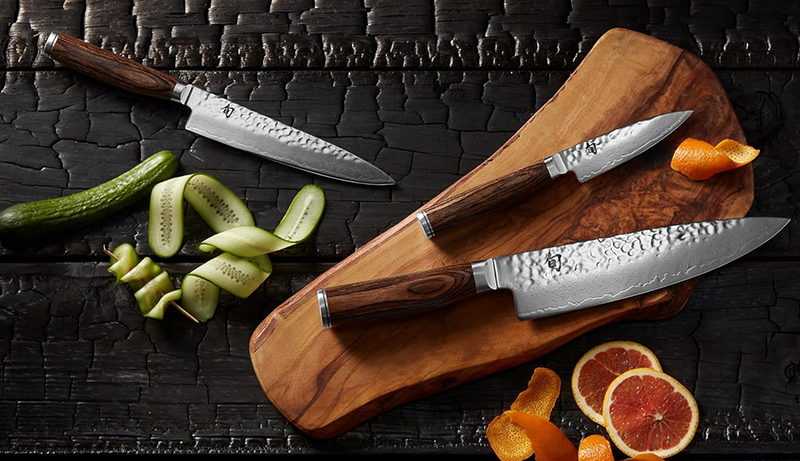
For over a thousand years, Japanese blacksmiths have been renowned for crafting exceptional blades—ranging from the legendary swords of samurai warriors to the precision slicers used by sushi chefs. Today, Japan continues this tradition, producing some of the finest knives in the world in a wide range of styles and designs, making it essential to understand what sets them apart.
Japanese knives are typically made from harder steel than their European or American counterparts. This results in a thinner, lighter blade that maintains a sharper edge for a longer period. However, working with this harder steel requires great skill, and many Japanese knives are still hand-forged using time-honored techniques, resulting in blades that are not only functional but also works of art.
Shun Premier
Ginsu Chikara
Yoshihiro VG10
Another defining feature of many Japanese knives is their single-beveled edge, meaning they are sharpened on only one side. This design allows for more precise control when cutting—provided you are slicing in the correct direction.
To help you find the perfect Japanese knife for your kitchen, we tested a selection of top-rated options in both professional labs and home kitchens.
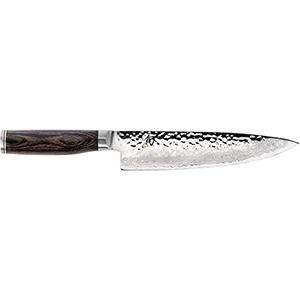
1. Shun Premier 8″ Chef’s Knife
Shun is renowned for crafting high-quality, well-balanced, and beautifully designed knives, and this all-purpose chef’s knife exemplifies that reputation. Featuring an 8-inch blade, it is ideal for a wide variety of kitchen tasks, including slicing, chopping, dicing, and mincing. The handle is ergonomically designed, offering a comfortable and secure grip that allows for precise and nearly effortless cutting, making it suitable for both professional chefs and home cooks.
The blade is forged from layered Damascus steel with a hammered finish, giving it an elegant, eye-catching appearance whether displayed on a knife rack or in use. Beyond aesthetics, the hammered finish serves a practical purpose—it minimizes food sticking to the blade, similar to the way a Granton edge works, allowing for smoother and faster cutting.
Although dishwasher safe, hand washing is strongly recommended to preserve the knife’s sharp edge and maintain its overall quality. In testing, the knife performed exceptionally well, delivering smooth, precise cuts with minimal pressure. The glossy wooden handle adds a touch of luxury while providing excellent control.
Over months of consistent daily use, the sharp edge retained its precision remarkably well, demonstrating Shun’s craftsmanship and the durability of its premium steel construction.
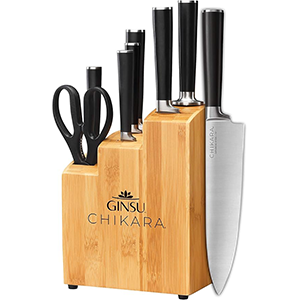
2. Ginsu Chikara 8-Piece Knife Set
When we tested various knife sets, this collection from Ginsu stood out as our top Japanese-style option. Perfect for anyone setting up a new kitchen or starting to cook at home, it offers a complete selection of essential knives at an excellent price point.
The Chikara set includes a chef’s knife, santoku, utility knife, paring knife, and serrated knife, along with a honing rod, a sturdy pair of kitchen shears, and a bamboo storage block. The blades are crafted from durable hard stainless steel, while the handles feature a lightweight, rounded design complemented by a solid bolster for added stability.
During testing, the sharpness of these knives was particularly impressive. The santoku performed exceptionally well, offering great balance and precision for a variety of tasks. The paring knife and chef’s knife also delivered excellent results, easily handling everything from hulling strawberries to dicing onions and slicing tomatoes with clean, smooth cuts.
Although the rounded handles appear simple, they provide a secure grip when held correctly, making them comfortable for extended use. Considering its sharpness, solid construction, and variety of knives included, this set delivers excellent performance and is an outstanding choice for anyone seeking quality Japanese-style knives at an affordable price.
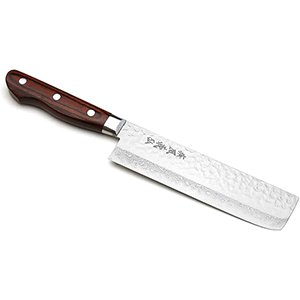
3. Yoshihiro VG10 16 Layer Knife
This rectangular knife is a nakiri, a traditional Japanese blade specifically crafted for precise vegetable cutting. Combining features of a chef’s knife and a cleaver, it is designed for clean, straight cuts, making it especially effective for chopping vegetables in an up-and-down motion. Its flat edge slices completely through fibrous produce, such as celery, without leaving strands intact, while the sturdy build gives it enough heft to handle tougher ingredients like potatoes and winter squash with ease.
The Yoshihiro nakiri stands out for its craftsmanship and striking appearance. Featuring a beautiful wavy Damascus steel pattern paired with a hammered finish, the blade is as functional as it is visually appealing. The hammered texture reduces food sticking, allowing for smoother, more efficient chopping. The handle, made of richly colored mahogany, has a Western-style ergonomic design that feels secure and comfortable during use, complementing the elegant look of the knife.
During testing, the Yoshihiro delivered ultra-clean, thin slices, with its shorter blade offering excellent control for detailed vegetable prep. Over six months of consistent use, the blade maintained its sharpness remarkably well. However, it requires proper care, including immediate washing and drying, to preserve its appearance and prevent discoloration.
4. MITSUMOTO SAKARI 8 inch Knife
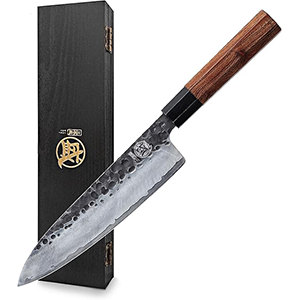
Japanese knives are often known for their high price due to the intricate craftsmanship involved, so finding a hand-forged option under $100 that performs exceptionally well is impressive. During testing, this knife delivered clean, precise cuts, gliding through paper and tomatoes, mincing chives with ease, and chopping onions effortlessly. It arrived razor-sharp and retained its edge remarkably well over six months of consistent use, showing excellent durability for its price point.
This knife is a gyuto, the Japanese equivalent of a classic chef’s knife. Its long, straight blade features a gentle curve, making it versatile for multiple cutting techniques, including rocking motions, straight up-and-down chopping, and smooth slicing. The blade is slightly thicker than many other Japanese knives, which can make cutting dense produce such as sweet potatoes more challenging, often requiring additional pressure. Its overall size is also substantial, with both a longer blade and handle, as well as a relatively heavy weight, giving it a more robust feel in hand.
Despite its heft, the knife performed very well in all standard kitchen tasks during testing. For those looking for a traditional Japanese-style knife at a fraction of the usual cost, this model offers exceptional value and solid performance.
5. TOJIRO JAPAN Professional Chef Knife
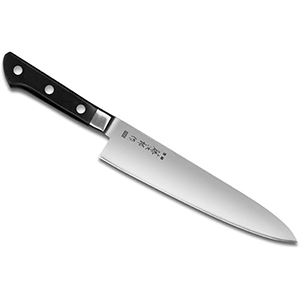
The gyuto is an incredibly versatile knife, suitable for cutting vegetables, fish, and meat. It closely resembles a Western-style chef’s knife, featuring a rounded blade that allows for rocking motions while chopping. Compared to typical Western knives, it is slightly longer and not as tall. The Tojiro DP Gyuto stands out as a reliable and high-performing option among Japanese knives. Straight out of the box, it easily sliced through paper, maintaining its sharpness even after extensive testing.
While the thin blade excels at precision tasks, it isn’t ideal for heavy-duty work like large-scale butchery or cutting through bones. One drawback noted was the handle design, which proved uncomfortable during prolonged use, especially when cutting tougher items like butternut squash. This caused some hand irritation, limiting comfort during extended preparation.
Overall, this knife delivers a consistently satisfying cutting experience. Its size strikes a good balance—not too long to feel unwieldy, nor too small to struggle with slicing vegetables and greens. For maintenance, using a whetstone is recommended to keep the edge sharp, which is typical for Japanese chef knives. The Tojiro DP Gyuto is a dependable workhorse, offering excellent value for its quality and performance, making it a top choice for a general-purpose kitchen knife.
What to Consider When Buying a Japanese Knife
Blade Shape and Size
Japanese knives come in a wide variety of styles, each designed for specific tasks. Among the most common are the santoku, gyuto, and nakiri. The santoku features a mostly flat blade edge, making it great for boning, fine slicing, and quick up-and-down chopping. It’s an excellent choice for those new to Japanese knives. The gyuto closely resembles a Western chef’s knife, with a rounded blade that allows for a smooth rocking motion while chopping. The nakiri, often called a vegetable cleaver, has a sharp, rectangular blade suited for slicing soft vegetables and pushing through harder ones like potatoes.
Size is also important. Knives come in different lengths, with longer blades covering more cutting surface but offering less precise control. Smaller knives are often preferred by those with smaller hands. Japanese knives tend to be lightweight, so even larger models are generally easy to handle.
Blade Material
Most knives are made from steel, a combination of iron and carbon. High-end Japanese knives often use high-carbon steel, which holds a sharp edge well but can be brittle and requires more care. Stainless steel contains chromium, which makes it rust-resistant and shiny but generally softer and less sharp-holding.
Handle
Comfort is key when choosing a knife handle. Japanese knives often feature rounded, oval, or D-shaped handles that provide a secure grip and ergonomic feel. Handle materials vary from unfinished wood, which may wear over time, to durable resin or composite materials. Many brands offer different handle shapes with the same blade styles to suit personal preferences.
Care and Maintenance
Proper care helps maintain the knife’s sharpness and longevity. Always hand-wash with warm, soapy water and dry immediately to avoid rust or mineral spots. Avoid dishwashers, abrasive scrubbers, and harsh detergents that can damage the blade. Use a soft sponge and clean the knife soon after use to prevent food residue from hardening.
Use cutting boards made of wood, plastic, or rubber to protect the blade. Hard surfaces like glass, granite, marble, or ceramic can dull or chip the edge. For storage, use a knife block, magnetic strip, or blade guards to keep knives safe and prevent damage.
Are Japanese Knives Worth It?
Japanese knives are prized for their sharpness, precision, and durability. Their handcrafted construction and high-quality materials make them more expensive but also valuable tools that can last a lifetime with proper care. For those who appreciate fine craftsmanship and superior performance, investing in a Japanese knife is often well worth it.


Leave a Reply